On the Origin of the Qur'an
The Qur'an is the collection of revelations transmitted to a previously unremarkable Meccan — though one known for his integrity — from a good but impoverished family, over the course of 23 years by a supernatural messenger (the angel Gabriel): Muhammad (s.a.w.). The first of these revelations reached the then 40-year-old Muhammad (s.a.w.), who could neither read nor write, suddenly and with great force in the month of Ramadan in the year 610, while he had withdrawn for contemplation and prayer in the cave of Hira high above Mecca (Surah 96, 1–5).

Muhammad (s.a.w.) was at that time — as one would say today — a commercial employee in the import-export firm of his (considerably older) wife Khadija, with whom he lived in a happy, monogamous marriage until her death (619). His last revelation he received shortly before his death in the year 632 in Medina. Between these two dates lie events which changed not only Muhammad (s.a.w.) himself but the entire world as profoundly as only the appearance of Jesus (a.s.) had done. Although nothing had previously indicated it, Muhammad (s.a.w.), under the impression of the revelations and with the authority and charisma of a messenger of God, became one of the most significant figures in world history. The message transmitted through him called into question not only the world of belief of Arabia at that time, but also ancient customs and practices, such as the customary law that had made the pre-Islamic woman without rights and had sanctioned the killing of newborn girls.
The Qur'anic message indeed placed the entire social, economic, and tribal-solidarity-based system of his homeland under scrutiny. Accordingly, most of his contemporaries reacted harshly: with mockery and slander, boycott, and assassination attempts — a persecution so severe that numerous Muslims in the year 615 had to temporarily flee as far as Abyssinia. Finally, Muhammad (s.a.w.) accepted an invitation from men and women of Yathrib (400 kilometres north of Mecca) who had become believers. Muhammad (s.a.w.) and his followers could now, from 622 onwards, emigrate in small groups to Yathrib, which from then on was called Medina ("the city," namely of the Prophet). With this key date the Islamic calendar begins. Here Muhammad (s.a.w.) established a state federation uniting the Muslim and Jewish tribes of the oases, for which he issued the first written state constitution in the world. This state was revolutionary because, for the first time in world history, it did not tie citizenship to criteria such as clan, race, skin colour, or language, but solely to a religious confession. Medina was to that extent an ideological state. As head of state, Muhammad (s.a.w.) developed astonishing statesmanlike, diplomatic, judicial, and military abilities, and this in a situation of strategic defence against Mecca's attempts to violently eliminate the Islamic danger — of which one still speaks today.

In the month of Ramadan 624, near Badr, southwest of Medina, a skirmish occurred that changed the world, because it gave the few Muslims the conviction that God was on their side. The struggle with Mecca finally ended with a diplomatic coup, the truce of Hudaybiyya near Mecca (628), an anticipated capitulation of Mecca. Indeed, in the year 630 the Muslims were able to take the city without a fight and with a general amnesty. And so there arose in the western Arabian Hijaz of the 7th century — so to speak in the lee of the two neighbouring hegemonic great empires, Byzantium and Persia — a vital community of faith that within a few decades extended as far as Spain, Persia, and India. Muhammad (s.a.w.), since 623 married to Aisha (r.a.), an extraordinarily intelligent young woman, now entered into several further, mostly dynastic marriages in order to consolidate the expanding Islamic state and its ruling elites among one another.
The Qur'an had repeatedly called upon the believers: "Believe in God and the Messenger." This authority worked true wonders of obedience and willingness to sacrifice among the early Muslims, up to their unique readiness to joyfully give their lives "for the cause of Allah" or "on the path of Allah." Already at that time the increasingly orthodox Muslim practice with its "five pillars" (confession of faith, five daily prayers, fasting during the month of Ramadan, social tax, pilgrimage to Mecca) and Islamic law (Sharia) took shape.
This immense success of a great idea brought Muhammad (s.a.w.) not only admiration. On the contrary: he became the most slandered, indeed demonized figure in world history altogether, reviled in the Christian Middle Ages not only as the Antichrist but as a hellhound (Luther!). What a contrast to the Qur'anic commandment to treat the "People of the Book," that is, Jews and Christians, kindly and to honour their prophets, including Jesus. Goethe wrote in "Poetry and Truth" that he could "never have regarded Muhammad as an impostor." The text of the Qur'an itself speaks plainly against its being an invention of Muhammad (s.a.w.), quite apart from the fact that the Prophet (s.a.w.) had never before demonstrated poetic or prophetic abilities: for there are in the Qur'an several sharp and, for Muhammad (s.a.w.), embarrassing reprimands of his misconduct.
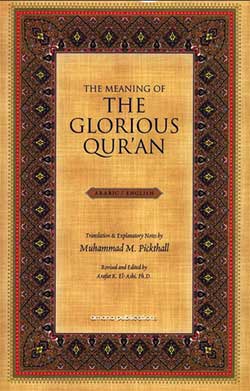
Nevertheless, by the nature of the matter, the conviction of the authenticity of the Qur'anic revelation, however plausible it may be, is first and last a matter of faith. Hence the Islamic confession of faith is not one-part but two-part: "I bear witness that there is no god but Allah, and I bear witness that Muhammad is the Messenger of Allah." The historicity of the Qur'an, on the other hand, can be scientifically proven. That the text as it exists before us is authentic — that is, corresponds to what thousands of Muslims knew by heart at the time of Muhammad's death — is no longer disputed even by Western Oriental studies. The situation with the Qur'an is in this respect different from that with the writings of the Old and New Testaments. These are known to come from different authors from different centuries; some of these authors are unknown, and numerous so-called texts have without doubt been manipulated. The actual founder of Christianity, Paul, did not even know Jesus (a.s.).

In contrast, the Qur'an is the best-attested text from late antiquity altogether. It is not only of one piece (apart from the non-chronological arrangement of the surahs), but has — computer-assisted language analyses corroborate this — a single author, whose linguistic peculiarities do not correspond to those of Muhammad (s.a.w.) (whose manner of speech, in turn, is best documented in countless reports (hadiths)). This is not the place to reproduce the history of the final redaction of the Qur'an in all its details (more information on this in Ahmad von Denffer, 'Ulum Al-Qur'an, Leicester 1983, as well as Ahmad Ali al-Iman, Variant Reading of the Qur'an, Herndon, VA 1998). In any case, the first caliph, Abu Bakr (r.a.), recognized one year after Muhammad's (s.a.w.) death that the Qur'an had to be fixed in writing in a coherent form, and that possible differences in small details should be standardized in the process. The basis for this was a text that Muhammad's secretary Zaid b. Thabit (r.a.) had carefully prepared. The third caliph, Uthman (r.a.), finally decreed in the year 653 that only the by-then consolidated text of the Qur'an, as we know it today, might be used. Of the official copies sent by him to Basra, Damascus, Kufa, Medina, and Mecca, two are still preserved. One is in the Topkapi Museum in Istanbul, the other in Tashkent. Curiously, the Qur'an was first printed in Germany, namely in 1694 in Hamburg. Today, the Arabic printed version that appeared in Cairo in 1925 is mostly used.
Tip for Using the (English-language) Qur'an:
The Qur'an, unlike the Bible, for example, has no chronological structure. It is therefore normally laborious and unsatisfying for a Westerner to read the Qur'an simply from front to back, also because of the repetitions that occur frequently in the Qur'an. In my view, it is much better to make the Qur'an part of daily reading, for example by reading a portion in the evening and relating it to the events of the day. In doing so, the passage is chosen purely at random, i.e. the Qur'an is opened at any place. One will find that the verses read "at random" in this way often stand in connection with the day's events and are very well suited to reflecting upon them. In this way the Qur'an most nearly fulfils the purpose intended for it, to be a guidance for mankind. This is also the best way for a relationship with God to develop, for the Qur'an is regarded by Muslims as the word of God.
Peculiarities of the Qur'an
The Qur'an possesses many peculiarities that make it clearly evident that such a book could not possibly have been written by an illiterate man of the 7th century. Please also read the following articles: "Numerical Peculiarities in the Qur'an" and "The Qur'an and Modern Science"
___________________________
Related articles:


