This article is partly or wholly incorporated into the book "The Fitnah of the Dajjal".
Default Mode Network
What comes closest to a material counterpart of an "I" or of our autobiographical self is, in the brain, the so-called Default Mode Network (DMN). It is something like our default setting in the brain. It filters and controls what comes at us — both from within, that is, memories and feelings, and from outside through the senses. Like a head of an authority, it determines what is allowed in, and also who in the brain is actually allowed to speak with whom. So that not everyone talks over each other in the head, it above all prevents too much communication. Most brain regions are not allowed to speak directly with one another. If the visual area were to exchange directly with the auditory area, for example, synaesthesia would occur. That means we then hear the visual or see music, as one can experience on psychedelic drugs. In short: the Default Mode Network puts us in a position to focus and to blank out a large part of our perceptions, memories, and sensations. It also enables us to communicate more effectively with other people, because in a society the individuals agree on a certain norm that tells them on what basis and with what understanding of reality one deals with one another.
Only in adults is this Default Mode Network fully developed; children, by contrast, still have a so-called lantern consciousness, in which everything is still evenly illuminated. The brain of the adult in the normal state, on the other hand, is a prediction machine. It tries to immediately classify information coming from outside into known models of reality and to take in just as much information as is absolutely necessary. Neuroscientists therefore also call this normal consciousness a "controlled hallucination."
Switching Off the Default Mode
The neuroscientist Robin Carhart-Harris and his colleagues inadvertently discovered an important function of the DMN. While they were studying brain networks, they became curious about what changes might occur when people are under the influence of psychedelic drugs. In studies analysing the effects of psilocybin on brain wave oscillation and blood flow, they found that an alternative consciousness network seemed to appear when the DMN was inactive.
When some subjects tested psilocybin, they reported a strong feeling of interconnectedness as well as spiritual, magical, and supernatural feelings. In the alternative mode, the brain produced a different world that offered different sensations and insights than in everyday life. In this mode, the (false) self was no longer the protagonist of the narrative.
Ego Switch
According to psychoanalytic theory, the feeling of personal identity is called the ego. It is the border-crosser and the gatekeeper who draws lines and separates us as individuals from others. Unfortunately, the default mode of modern man is substantially more individualistic and egocentric than that of prehistoric man, who still saw himself more as part of a great organism, both of the tribe and of nature. Only "modern thinking" has set the default mode extremely toward demarcation.
As we now know from experiments with psilocybin and from the experiences of spiritual people, it is possible to dim or even switch off the default mode. In doing so, the connections between cortical regions are changed and new modes, new sensations, and thoughts are activated. Experiencing this state can lead to lasting changes, even after the effect of the psilocybin subsides. For someone who is severely depressed, a change in brain activity may possibly shake them out of a cognitive rut, in which their default mode repeats negative thoughts and feelings in a damaging loop, explains Carhart-Harris. And in someone who is psychologically healthy, the additional perspective that a look at the alternative consciousness offers can also improve general well-being.
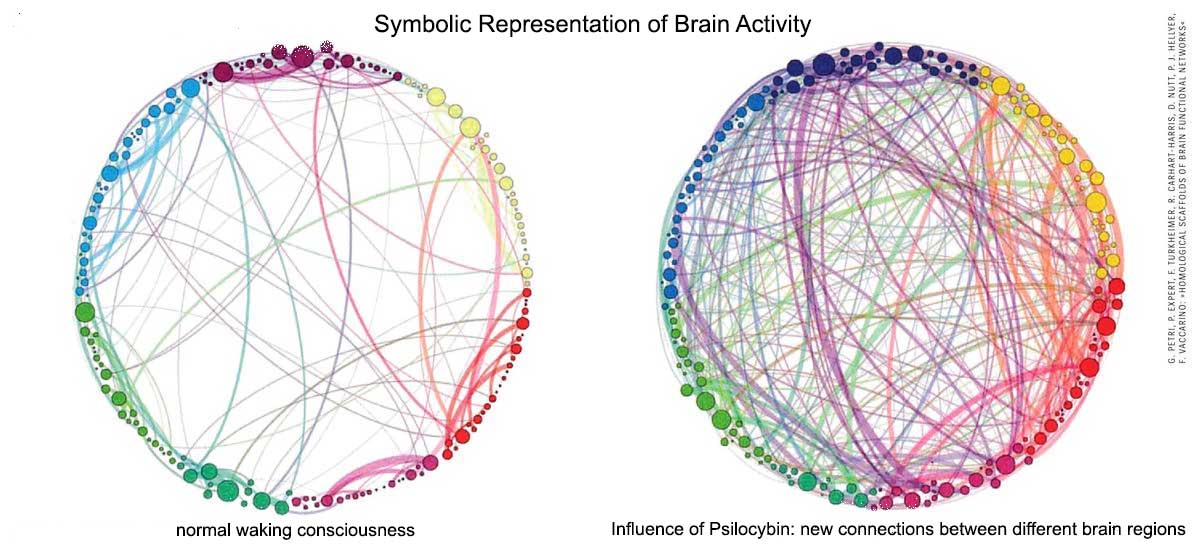
Three studies with psilocybin on 36 healthy volunteers showed that brief, drug-induced mystical experiences that changed people over time and led them to experience better moods, increased altruism and forgiveness, and greater closeness to others, and six months later a feeling of connection. The ego began to dissolve, which brought consistently positive experiences with it. An epiphany triggered by psilocybin can evoke new enthusiasm, curiosity, or a sense of wonder that can trigger behavioural changes and new interests, which for example stimulate travel, contemplation, meditation, an interest in nature, people, or other cultures.
However, no momentary experience is as a rule so magical and profound that it could permanently change a person. Dissolving the ego does not happen once and for all. The DMN resumes its tasks, and it can be difficult to stay in contact with alternative states of consciousness. Moreover, it can be dangerous to radically manipulate consciousness, especially for people who suffer from psychological problems and take it at the wrong time and in the wrong place. One can also become more susceptible to attacks by jinn. And there are doubts as to whether psychedelic drugs such as psilocybin, peyote, LSD, or ayahuasca are Islamically legitimate or whether they fall under khamr (1), which most scholars would probably claim (without of course ever having tried these drugs themselves).
When the taking of psychedelic drugs is combined without other forms of spirituality, it generally leads to no lasting positive changes. Without the strong metaphysical foundation of a revealed religion, one will normally not get far, while Islam also gets along well without psychedelic drugs, scientific findings, or comparison to other religions. But it can certainly be helpful to occasionally view one's own standpoint from another perspective.
Dissolution of Boundaries
Spiritual experience takes the opposite path from analytical-rational thinking and dissolves boundaries. Mystics arrive at an answer by not questioning absolute reality (bila kaifa), but rather surrendering to it (tawakal) and thereby dissolving the boundary of the ego (fana, mahw). Overcoming the boundary automatically goes hand in hand with a feeling of union (jam') with others and with life itself. For we are in truth not individuals who exist in lonely bodies. We are a flowing segment in the uninterrupted line of life. What makes people sad and hostile is a false feeling of separation from one another and from the rest of the world.
Religion points to various ways of breaking the dominance of the ego and bringing it under the control of "the whole," so that man does not perceive himself as an isolated particle but as part of the Ummah (community of believers), as part of humanity, as part of the entire creation, and builds a connection to God. Indeed, the word "religion" means re-binding (from the Latin re-ligere), and the word yoga also has the basic meaning "connection, union."
Seeking God means seeking unity and connection, while modern science based on rational analytical thinking leads to demarcation and separation, with all the well-known results of a destroyed world and isolated individuals. In almost all religions one therefore finds practices not only to change the false "I" perspective but also to bring the polar-operating thinking under control, which are ultimately only two sides of the same coin.
(1) Khamr is an Arabic word for wine, specifically wine made either from grapes or dates. Because of the hadith "Every intoxicant is khamr, and every khamr is forbidden," most scholars are of the opinion that all drugs are generally forbidden. However, Ibn Rushd al-Qurtubi explains in his encyclopaedia of comparative Islamic jurisprudence that the Qur'an explicitly established that the underlying reason for the prohibition of khamr is that it hinders the remembrance of God and generates hostility and hatred. But psychedelic drugs do not have precisely this effect, but precisely the opposite.
___________________________
Related articles:


